For most of the history of the campaign yard sign, one color on white was not a style. It was a price. Signs were screen printed, every color needed its own screen and its own pass, and a campaign on a budget bought one color, maybe two. The white border came with it: the ink stopped short of the edge because the press did.
That is not how a yard sign is made any more, and the voters driving past can tell the difference even if they could not tell you why.
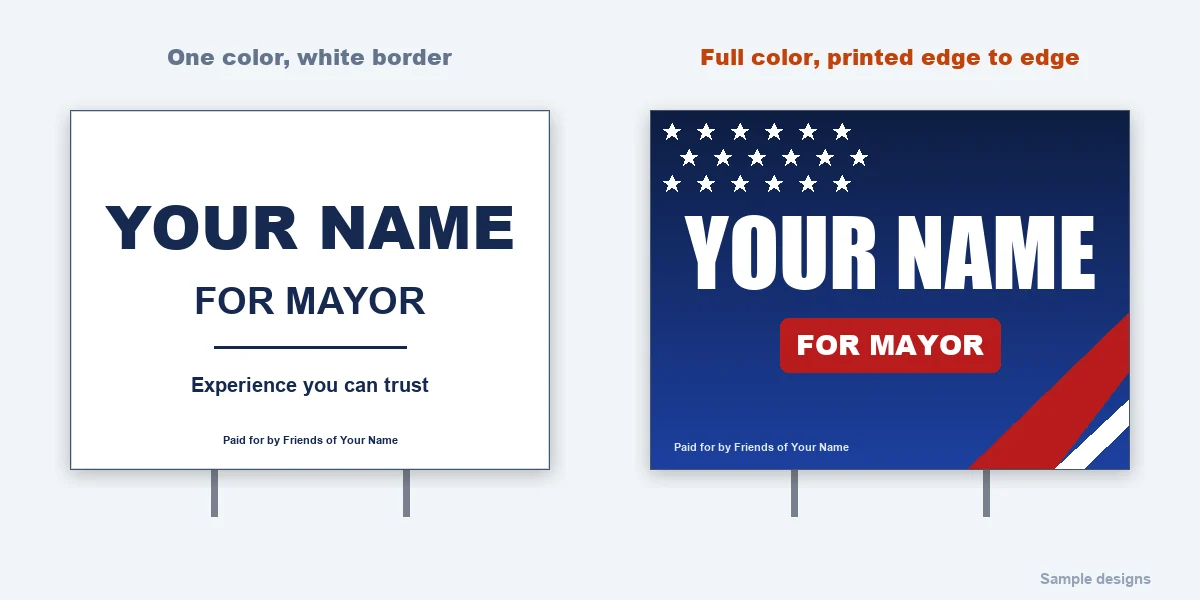
The one-color sign was a cost decision
A sign printed digitally — UV ink cured straight onto the coroplast — prints every color in the same pass. There is no screen to make and nothing to charge per color, so a navy background, a red band and a field of white stars cost exactly what black on white does. On our signs the price is the pack price whatever the design: $95 for 10, $674 for 100 with campaign pricing.
Once the price is the same, the only question left is which sign looks more like the office you want.
What edge to edge does from the road
A sign is read at 30 miles an hour from 30 to 50 feet away. At that distance the eye takes in shape and color before it reads a single letter. A background that runs to the edge turns the whole 24″ × 18″ board into the sign; a white border makes it read smaller, and on a white lawn-side fence it can disappear. Printed edge to edge, the sign looks finished — closer to a billboard than to a flyer.
It is the same reason campaigns spend money on a good headshot and a pressed shirt. Nobody votes for a sign. But a sign that looks like a weekend project quietly tells people what kind of campaign it is.
Use color like a signal
- Two or three colors, chosen on purpose. A dark ground, a light name, one accent. Full color is permission to choose, not an instruction to use them all.
- Contrast first. White or yellow on navy, navy on white, white on red. Avoid red type on blue and blue type on red: they vibrate and blur at a distance.
- Color says something before the words do. Navy and gold read established. Red, white and blue read energetic. Green and gold read local. Which look suits which office is its own guide.
What full color is not for
It is not for more words. The rules of a campaign sign do not change because the ink got cheaper: the last name is the largest thing on the sign, the office is one line beneath it, a slogan gets three words at most, and the “Paid for by” line sits small along the bottom. It is rarely for a photo, either — a face at 40 feet is a smudge. What full color is for is the finish: the background, the band, the stars, the color of the office.
The checklist
- Last name as large as the sign allows
- Office on one line beneath it
- Two or three colors, high contrast, background printed to the edge
- “Paid for by” small along the bottom, in the wording your state asks for
- Double sided for corners and medians, single for lawns facing one way
What it costs
| Signs | Single sided | Double sided |
|---|---|---|
| 10 | $95 | $125 |
| 25 | $219 | $279 |
| 50 — 10% off | $359 | $449 |
| 100 — 10% off | $674 | $836 |
| 250 — 10% off | $1,574 | $1,934 |
Campaign pricing: 10% off the signs on orders of 50 or more from our campaign pages, no code to type. Every sign is 24″ × 18″, full color, printed edge to edge, with a steel H-stake and free FedEx Ground shipping.
Common questions
Does full color cost more on a campaign yard sign?
Not at Sign Blast USA. The signs are printed digitally, so there is no per-color charge: $95 for 10, and $674 for 100 with campaign pricing (10% off 50 or more), whether the design is one color or a photo.
What does edge to edge mean on a yard sign?
The print runs all the way to the cut edge of the sign, with no unprinted white border. The background color, a band or a field of stars goes right to the edge, which is what makes a sign look finished from the road.
Should a campaign sign have a photo of the candidate?
Rarely. From a moving car a face is a smudge, and it takes room from the name. A photo works on a palm card or a door hanger; on the yard sign, spend the space on the last name.